
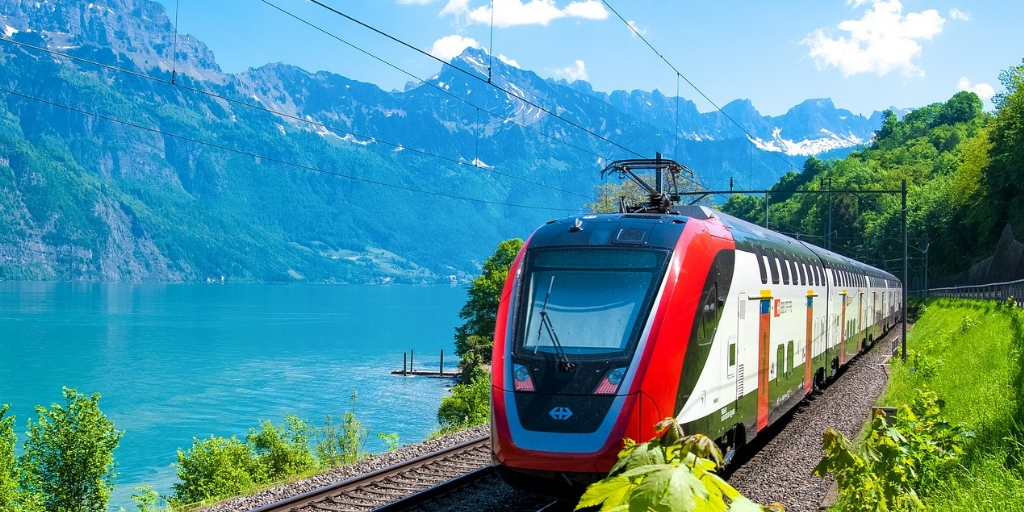
Train travel is widely considered one of the most sustainable ways to explore a country because rail typically produces far fewer emissions per passenger than both cars and planes, especially on short- to medium-distance routes. Recent reporting and climate-focused transport sources note that rail can emit many times less carbon than flying, with one recent comparison stating that a rail journey can produce 13 times less carbon than the equivalent flight and 10 times less than the same trip by car.
That environmental advantage matters even more when looking at the broader transport picture. The European Environment Agency reported that transport emissions in Europe were still rising slightly in 2024, while reporting in early 2026 noted that transport accounts for roughly a third of the European Union’s greenhouse gas emissions, with road transport responsible for nearly three quarters of that sector total. In that context, train travel is not just a convenient alternative; it is one of the clearest practical ways for travelers to reduce the climate impact of moving around a country.
Lower emissions by design
The biggest reason train travel stands out is simple: rail is efficient by design. A single train can carry large numbers of passengers in one movement, which spreads energy use across many people instead of repeating it in hundreds of separate cars or multiple flights. That efficiency is one reason sources cited by Climate Action Accelerator say trains produce between seven and more than 40 times fewer emissions than airplanes.
Other recent comparisons reinforce that point. Nature wrote in 2025 that rail produces about one-fifth of the emissions of car transport per passenger-kilometer and less than one-quarter of those of flying. Our World in Data also notes that replacing medium-distance car travel with rail can cut emissions by around 80%, and using rail instead of a domestic flight can lower emissions even more sharply.
On some routes, the difference is dramatic. Thrust Carbon reported that a London-to-Edinburgh trip produced 12.5 kg CO2e per passenger by train, compared with 136.4 kg CO2e by car and 165.1 kg CO2e by plane. Even allowing for route-specific conditions, occupancy, and methodology, the pattern is consistent: trains generally outperform both planes and private cars on emissions.
Better use of energy
Train travel is also more sustainable because it makes better use of energy systems, especially when rail networks are electrified. Unlike planes, which rely heavily on aviation fuel, and unlike many private cars, which still depend on combustion engines, electric rail can benefit directly from cleaner power grids over time.
That means train sustainability can improve as national electricity systems improve. SolarTech’s 2025 emissions guide notes that rail emissions vary depending on the electricity mix, with renewable-powered grids producing much lower passenger-kilometer emissions than coal-heavy ones. In other words, rail is not only lower-impact today in many countries; it also has a clearer path to becoming even cleaner tomorrow.
This is an important advantage for national exploration. When a country invests in electrified rail and cleaner energy, every passenger journey on that system becomes part of a broader decarbonization strategy. That is much harder to achieve with aviation, where fuel alternatives remain limited and high-emission short-haul flying is still common.
Stronger than flying for domestic trips
For travelers exploring a single country, trains are especially sustainable because they are well suited to the kinds of distances many domestic trips involve. Climate Action Accelerator says trains can compete with air travel on routes up to 700 km, especially where high-speed rail exists, and that for many short- to medium-haul journeys rail can even be faster once airport procedures and airport-to-city transfers are considered.
This matters because domestic and regional flying often looks efficient only on paper. A one-hour flight may actually involve several more hours of check-in, security, boarding, waiting, and transfer time. Train stations, by contrast, are usually more central and require far less pre-departure time, which means the total journey can be competitive while producing far fewer emissions.
There is also major climate value in shifting domestic travel away from planes. Climate Action Accelerator notes that moving half of UK domestic flights to rail would save nearly 410,000 tonnes of carbon annually, equivalent to removing 283,000 cars from the road. That helps explain why rail is increasingly seen not just as a niche eco-option, but as a central climate solution for internal travel.
Lower impact beyond carbon
Sustainability is not only about carbon emissions. Trains can also have lower broader environmental impacts than road and air transport when it comes to land use, air quality, and noise. A 2025 high-speed rail analysis notes that rail infrastructure can use far less land per passenger-kilometer than car-based infrastructure and can reduce pollutants such as nitrogen oxides and particulate matter compared with road transport.
That does not mean rail has no footprint. Rail lines require construction, maintenance, and energy, and large infrastructure projects can carry major environmental costs during the building phase. But over time, heavy passenger use can spread those impacts across far more journeys than car-based travel systems or repeated short-haul flights, improving the long-term sustainability case for rail.
For travelers, this means the environmental benefit of rail often extends beyond the narrow question of fuel burned on a single trip. Rail supports denser mobility patterns, reduces dependence on highways and airport expansion, and can make lower-impact national travel normal rather than exceptional.
A better way to see a country
Train travel is also sustainable in a cultural and practical sense because it encourages a different style of tourism. Flying often compresses travel into isolated jumps from one airport zone to another, while trains let people move through landscapes, regional towns, and intermediate cities in a continuous way. That slower form of travel often leads to longer stays, fewer rushed connections, and a more distributed tourism footprint.
This matters when exploring a country in depth. Rail makes it easier to discover second-tier cities and less crowded regions, rather than concentrating tourism only in the biggest flight-linked destinations. By spreading visitor activity more broadly, train travel can support local economies beyond major hubs and reduce pressure on overvisited places.
Train stations also tend to connect directly to city centers and local public transport systems. That reduces the need for extra car trips, taxis, or airport shuttles and makes it easier for travelers to continue using low-impact transportation after arrival. In practical terms, rail does not just replace the flight; it often supports a lower-impact itinerary from start to finish.
The role of high-speed rail
Where it exists, high-speed rail strengthens the sustainability case even further. Recent analysis on high-speed rail argues that this mode consistently outperforms cars and short-haul aviation in emissions per passenger-kilometer, with some long-distance trains in France reported at roughly 3 g CO2e per passenger-kilometer and broader high-speed rail ranges estimated at 3 to 11 g CO2e per passenger-kilometer depending on system and assumptions.
These low figures are one reason high-speed rail is often positioned as a climate-friendly substitute for domestic flights. The same analysis says high-speed rail can cut transport emissions by up to 95% compared with some car or plane journeys, while national rail systems in France and Spain have reportedly avoided millions of tonnes of CO2 annually.
Of course, not every country has a high-speed network. But even conventional rail often remains a strong environmental choice, especially when trains are well used and integrated with other public transport. The broader lesson is that as rail quality improves, its sustainability advantage becomes even harder to ignore.
Not perfect, but still the best option
It is worth being honest: train travel is not automatically perfect in every case. Its impact depends on factors such as occupancy, energy source, infrastructure quality, and whether the route actually replaces a flight or a car trip. In some countries, outdated diesel rail or weak service coverage may reduce the environmental and practical advantage.
Still, the balance of evidence strongly favors rail as the most sustainable mainstream option for exploring a country where service exists. Compared with private cars, rail generally lowers emissions and reduces congestion. Compared with flying, it can slash carbon output while often delivering city-center convenience and a richer travel experience.
That combination is what makes rail so compelling. It is not only greener in theory; it is often genuinely usable, comfortable, and efficient in practice. For travelers who want to reduce their footprint without giving up mobility, trains offer one of the rare cases where the sustainable option can also be the more enjoyable one.
Choosing trains to explore a country is ultimately about more than transportation. It is a decision to travel in a way that uses less energy per person, creates fewer emissions, integrates better with public infrastructure, and opens the door to slower and more connected tourism. In a time when transport emissions remain a major climate challenge, rail stands out as the clearest path toward lower-impact domestic travel.