
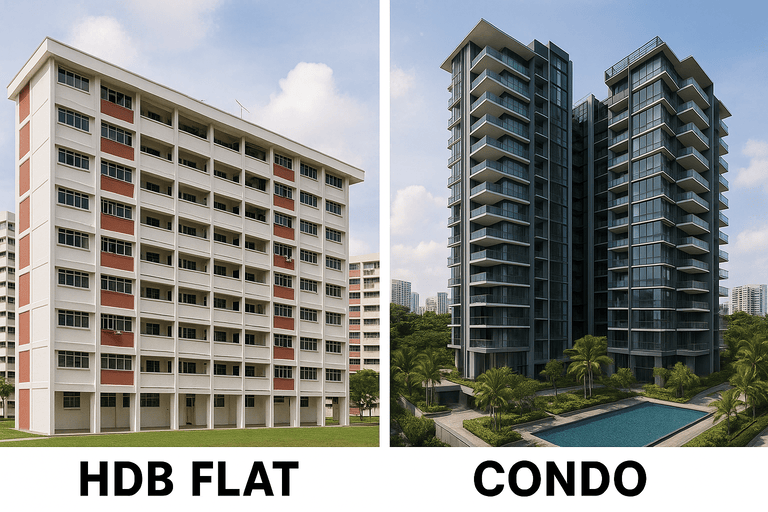
Buying your first home in Singapore is one of the most consequential financial decisions you will ever make. The choice between an HDB flat and a private condominium isn’t simply a lifestyle preference — it determines your upfront costs, your monthly cash flow, your investment trajectory, and your financial flexibility for the next decade or more. Both options have genuine merits and meaningful drawbacks, and the right answer depends entirely on your income, family situation, long-term goals, and risk tolerance. This guide breaks down every major dimension of the HDB vs condo decision so you can choose with clarity and confidence.
The Price Gap Is Enormous
The most immediate and impactful difference between HDB flats and condominiums is price. A four-room HDB flat in a non-mature estate like Woodlands, Tampines, or Jurong East typically costs between SGD 400,000 and SGD 550,000 in the resale market. A three-bedroom condo in the same geographic area will almost certainly cost SGD 1,000,000 or more — often significantly more in 2026 given the continued upward pressure on private residential prices across Singapore.
This price gap translates directly into downpayment requirements and monthly mortgage obligations. On a SGD 500,000 HDB resale flat with a 25% downpayment, you need SGD 125,000 upfront, of which 5% (SGD 25,000) must be in cash and the remainder can come from CPF Ordinary Account savings. On a SGD 1,200,000 condo purchase under the same terms, your downpayment is SGD 300,000 — more than double — with the same 5% cash floor translating to SGD 60,000 in cash alone. For most first-time buyers, especially younger couples in the early stages of their careers, this financial gap is the decisive factor.
Government Grants: HDB’s Unbeatable Advantage
One of the most powerful — and frequently underestimated — advantages of buying an HDB flat as a first-time buyer is access to substantial government grants. Private condominiums receive no equivalent government housing subsidies.
First-time HDB buyers can access the Enhanced CPF Housing Grant (EHG) of up to SGD 80,000 depending on household income. Additional grants include the Family Grant of up to SGD 50,000 for resale flat purchases and the Proximity Housing Grant (PHG) of up to SGD 30,000 for buyers living near their parents. A first-time couple purchasing an HDB resale flat in 2026 could theoretically access SGD 80,000–160,000 in combined grants — money that is applied directly to reduce the purchase price and does not need to be repaid as long as eligibility conditions are met.
These grants fundamentally shift the true cost comparison between HDB and condo. When grant entitlements are factored in, the effective price of a well-located HDB flat for an eligible first-time buyer is far lower than the sticker price suggests — widening the affordability gap with private condominiums even further.
Financing Rules: MSR vs TDSR
Singapore’s property loan framework treats HDB and private property buyers differently, and understanding this distinction is critical.
HDB flat purchases are governed by the Mortgage Servicing Ratio (MSR), which caps your monthly loan repayment at 30% of your gross monthly income. This is a stricter cap designed to ensure HDB buyers don’t overextend on housing. If your household earns SGD 8,000 per month, your maximum monthly HDB mortgage is SGD 2,400.
Private condo purchases fall under the broader Total Debt Servicing Ratio (TDSR), which allows total debt obligations — including your mortgage — of up to 55% of gross monthly income. This means the same SGD 8,000-per-month household can theoretically service a condo mortgage of up to SGD 4,400 per month (assuming no other debts). While this creates greater borrowing capacity on paper, it also creates the risk of being house-poor — technically able to afford the mortgage while having little discretionary income left for savings, investments, or emergencies.
Additionally, HDB buyers can access the HDB concessionary loan at 2.6% interest per annum — a stable, government-subsidized rate that doesn’t fluctuate with market interest rates. Private condo buyers must use bank loans, which in 2026 carry rates that can range from 2.8% to 3.8% or higher depending on the loan package and SORA movements. Over a 25-year loan term, even a 0.5% interest rate difference translates into tens of thousands of dollars.
Eligibility: Not Everyone Can Choose HDB
The HDB vs condo decision isn’t always entirely voluntary — eligibility restrictions can narrow your options significantly.
To purchase an HDB flat in Singapore, at least one buyer must be a Singapore Citizen, and buyers must form a valid family nucleus — meaning a married couple, a couple with children, or a family unit. Singles can only purchase HDB flats (specifically two-room Flexi flats or resale flats) after the age of 35. There are also household income ceilings for BTO applications — typically SGD 14,000 per month for families — and ethnic quota restrictions in certain blocks.
Private condominiums, by contrast, have no eligibility restrictions beyond financial capacity. Singapore Citizens, Permanent Residents, and foreigners can all purchase condos (though PRs and foreigners pay Additional Buyer’s Stamp Duty). For couples where one partner is a foreigner and neither qualifies under HDB’s family nucleus rules, a private condo may be the only viable homeownership path.
Minimum Occupation Period: The HDB Lock-In
One of the most significant — and often frustrating — restrictions for HDB buyers is the Minimum Occupation Period (MOP) of five years. During this period, HDB flat owners cannot sell their flat on the open market, rent out the entire unit, or purchase a private residential property in Singapore. The MOP effectively locks buyers into their first home for at least five years before any upgrading strategy becomes executable.
Private condominiums have no MOP. You can sell a condo the day after you move in (though selling within three years incurs Seller’s Stamp Duty of up to 12%), rent it out immediately, or make any property transaction without waiting. For buyers who value flexibility — whether due to career mobility, family size uncertainty, or investment goals — this is a meaningful advantage for condos. For buyers with a clear long-term residential plan, the MOP is largely irrelevant in practice.
Amenities and Lifestyle: Condo Wins on Comfort
There is no denying that private condominiums offer a superior amenities package by design. Most condos include swimming pools, fully equipped gymnasiums, BBQ pits, function rooms, 24-hour security, and landscaped common areas. For families with children or active individuals who value these facilities, the condo lifestyle offers genuine daily quality-of-life benefits that HDB common areas simply cannot replicate.
However, these amenities come at a recurring cost. Condo monthly maintenance fees in Singapore typically range from SGD 200 to SGD 600 per month depending on the development size and facilities. HDB conservancy charges, by comparison, are SGD 20–90 per month depending on flat size. Over a 10-year ownership period, the differential in maintenance fees alone can amount to SGD 24,000–60,000 — a real cost that first-time buyers frequently underestimate when comparing total ownership costs.
Investment Potential: A Nuanced Comparison
Both HDB flats and condos can generate strong capital appreciation in Singapore’s tightly constrained land market, but the dynamics differ meaningfully.
HDB flats are sold on 99-year leases from the date of first sale. As the lease shortens, resale value typically declines — particularly once a flat drops below 60 years remaining lease, at which point CPF usage restrictions and bank loan limitations kick in. Long-term capital appreciation for HDB is real but bounded by lease decay and government resale price guidelines.
Private condominiums — particularly freehold developments or those on 999-year leases — have no equivalent lease decay concern and can appreciate more freely in line with private residential market demand. Condos can also be fully rented out with greater flexibility after the Seller’s Stamp Duty window passes, generating rental income that HDB rules make more difficult to maximize.
That said, the HDB-first, condo-upgrade strategy remains the dominant and most financially sound path for most Singaporean families. Buying an HDB flat first, benefiting from grants, building equity over the five-year MOP, and then selling to upgrade to a condo using accumulated CPF and cash proceeds has produced strong outcomes for generations of Singaporean homeowners.
Side-by-Side: Key Differences at a Glance
| Factor | HDB Flat | Private Condo |
|---|---|---|
| Typical Price (3–4 room) | SGD 400K–600K | SGD 900K–1.5M+ |
| Government Grants | Up to SGD 160,000 | None |
| Loan Type | HDB loan (2.6%) or bank | Bank loan only |
| Loan Servicing Cap | MSR: 30% of income | TDSR: 55% of income |
| Minimum Occupation Period | 5 years | None |
| Amenities | Basic (void deck, playground) | Pool, gym, security |
| Monthly Maintenance | SGD 20–90 | SGD 200–600 |
| Eligibility | Citizens only; family nucleus required | Open to all buyers |
| Lease | 99 years | Freehold or 99 years |
| Rental Flexibility | Restricted during MOP | Immediate |
Who Should Buy HDB First?
For the majority of first-time buyers in Singapore — especially young couples, newly married pairs, and families with moderate incomes — the HDB route is the strategically superior starting point. The combination of lower entry cost, substantial government grants, access to the HDB concessionary loan, and the proven HDB-upgrade pathway makes it the most financially efficient way to enter Singapore’s property market.
Who Should Consider a Condo First?
Buying a condo as a first home makes sense in specific circumstances: couples who don’t meet HDB eligibility due to citizenship or family nucleus restrictions; high-income households earning above SGD 14,000 monthly who don’t qualify for BTO grants anyway; buyers who need immediate rental flexibility; and individuals above 35 who don’t want to wait for HDB eligibility or BTO timelines. For these buyers, a strategically chosen condo in a well-connected, high-demand area can deliver both lifestyle satisfaction and long-term capital appreciation.
The HDB vs condo decision ultimately isn’t about which option is objectively better — it’s about which option is better for you, given your income, family structure, timeline, and financial goals. Run the numbers honestly, factor in grants and total ownership costs, and make the decision from a position of full information rather than lifestyle aspiration alone.