
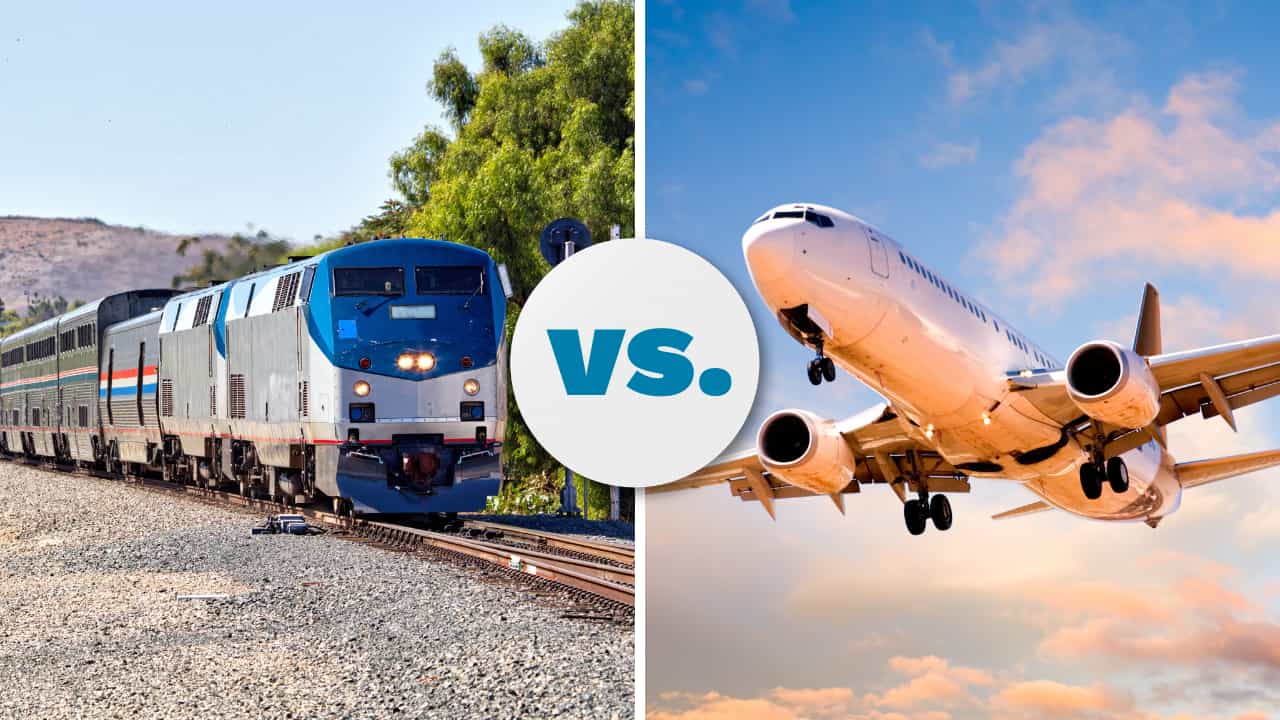
Modern travel has made movement faster than ever. A person can cross countries in hours, reach another continent overnight, and treat distance as a minor inconvenience. But the speed of modern travel comes with a serious environmental cost, especially when flying becomes the default option. As climate concerns intensify, more travelers are comparing the impact of flying with lower-emission alternatives, and train travel stands out as one of the clearest comparisons. Across many routes, trains generate far less pollution than planes, especially when the rail system is electrified and heavily used.
The difference is not just a matter of personal preference. It reflects basic physics, infrastructure, and energy systems. Airplanes must lift heavy aircraft into the sky, burn large amounts of fuel during takeoff and ascent, and operate in a sector that remains difficult to decarbonize. Trains, by contrast, move along fixed tracks with far less friction and can carry many passengers efficiently at once. This makes rail one of the lowest-impact forms of motorized long-distance travel on many routes.
Why planes emit more
Flying has a high environmental impact because aircraft require intense energy use to stay airborne. Aviation emissions are not evenly distributed across the trip. A large share of fuel is burned during takeoff and climb, which makes short-haul flights especially inefficient. The New York Times reported that experts note planes burn the most fuel during takeoff and ascent, which is one reason short flights are particularly emissions-heavy relative to the distance covered.
Planes also create warming effects beyond carbon dioxide alone. A BBC climate comparison noted that for a London to Madrid journey, the flight emitted 118 kilograms of CO2 per passenger, but the figure rose to 265 kilograms when non-CO2 effects were included. CarbonClick likewise explains that emissions released at high altitude intensify aviation’s climate impact and cites research suggesting warming effects can be between 1.27 and 2.5 times greater than ground-level CO2 alone because of atmospheric effects such as radiative forcing.
Seat class matters too. CarbonClick states that business class seats can produce roughly three to four times the emissions of economy class because fewer passengers share the space and fuel burn. That means the environmental burden of flying is not only about the aircraft or route, but also about how efficiently the cabin is used.
Why trains usually perform better
Trains generally have a lower environmental impact because they move large numbers of people with much less energy per passenger. Our World in Data says that using a train instead of a domestic flight would reduce emissions by around 86 percent. CarbonClick adds that aircraft emit about 285 grams of CO2 per passenger-kilometer, compared with an average of 41 grams for UK trains, while highly efficient electrified rail services such as Eurostar can be as low as 6 grams per passenger-kilometer.
Part of this advantage comes from efficiency. Steel wheels on steel rails create less rolling resistance than rubber tires on roads, and trains do not need to generate lift the way planes do. But electrification is also a major reason rail can be so clean. The New York Times noted that electrification is already widely available for trains, and that rail becomes even cleaner as power grids add more wind and solar energy.
This means train emissions can improve over time in a way that aviation struggles to match. A cleaner electricity grid lowers rail emissions automatically, while aviation still depends heavily on liquid fuels and faces a slower path to decarbonization.
Comparing real routes
The environmental gap becomes easier to understand when looking at actual routes. The BBC reported that a London to Madrid trip emits 43 kilograms of CO2 per passenger by train, compared with 118 kilograms by plane, or 265 kilograms if non-CO2 effects are included. CarbonClick gives another striking example: a London to Paris journey produces around 22 kilograms of CO2 by train compared with 244 kilograms by plane, based on a Eurostar study.
Other route comparisons point in the same direction. CarbonClick says train travel can reduce emissions by 73 to 91 percent on many popular routes and cites London to Nice as 36 kilograms of CO2 by train versus 250 kilograms by air. Seat 61 similarly states that taking the train instead of flying between London and Paris cuts CO2 emissions by about 90 percent.
Not every route has the same ratio, but the pattern is consistent on many short- and medium-haul city pairs. Carbon Tracker gives the example of Paris to London at roughly 105 kilograms of CO2e by flight versus about 10 kilograms by Eurostar, which it describes as a 90 percent reduction. On New York to Washington, D.C., the same source estimates around 125 kilograms of CO2e by flight versus about 25 kilograms by train.
Distance changes the equation
Although trains usually come out ahead, the gap is not identical across all distances. The New York Times reported that for most travelers making trips of around 300 to 400 miles, trains remain the more environmentally sustainable choice, and cited a 2022 U.S. Department of Transportation study showing rail between Los Angeles and San Diego produced less than half the emissions per passenger of flying or driving, while rail from Boston to New York produced less than one-fifth the emissions of flying or driving.
However, the same reporting noted that once distances exceed roughly 700 miles, planes can begin to compare more favorably than trains in some contexts, especially where rail is diesel-powered or indirect. That does not mean flying becomes low-impact. It means the relative efficiency of aviation improves somewhat over longer distances because the high fuel burn of takeoff is spread across more miles.
Even then, connections matter. The New York Times also reported that flights on the same route can vary in emissions by a factor of three, and that multiple connections increase emissions due to repeated takeoffs and landings. So a nonstop flight may perform better than a connecting one, while an electrified direct rail route may outperform both by a wide margin.
Beyond carbon dioxide
The environmental comparison is not only about CO2. CarbonClick says rail travel also reduces local pollutants and noise compared with aviation, stating that rail can cut nitrogen oxides by around 50 percent and particulate matter by up to 90 percent relative to road transport, while trains typically operate at 50 to 75 decibels compared with aircraft noise levels of roughly 85 to 105 decibels.
Aviation’s high-altitude emissions also matter because they affect the climate differently from emissions at ground level. The BBC comparison explicitly highlights how including non-CO2 effects makes the climate cost of flying much higher than CO2-only figures suggest. That is an important distinction because many consumer-facing emissions estimates still focus too narrowly on carbon dioxide alone.
Train travel also tends to reduce the need for large airport infrastructure, long security processes, and the road traffic associated with airports located far from city centers. Carbon Tracker notes that city-center to city-center rail trips can cut the “last mile” emissions that often come with airport transfers.
Why flying still dominates
If trains are usually cleaner, why do so many people still fly? One reason is pricing. Earth.org reported on a European study showing that flights are often cheaper than trains despite being much more polluting, and summarized the finding that flights emit on average about five times more CO2 per passenger-kilometer than trains. This suggests that market incentives often push travelers toward higher-emission choices.
Time perception is another factor. Many people compare only the scheduled duration of a flight with the timetable of a train, not the full door-to-door journey. Carbon Tracker argues that on short-haul city pairs, trains are often just as fast overall once airport transfers and waiting time are included. Seat 61 also emphasizes that airport check-ins can erase much of the apparent time advantage of flying on shorter routes.
Infrastructure is the third issue. Trains are only a practical alternative where rail networks are reliable, frequent, and reasonably priced. The environmental case for rail is strongest in countries and corridors with electrified lines, central stations, and efficient booking systems.
What travelers can do
For travelers trying to reduce their footprint, the most effective strategy is usually to replace short- and medium-haul flights with trains whenever practical. Our World in Data’s estimate of an 86 percent reduction from replacing a domestic flight with rail makes this one of the highest-impact choices many travelers can make.
A few practical habits help:
- Choose rail first for trips between major cities where good train service exists.
- Favor economy over premium cabins when flying is unavoidable, since cabin class changes per-passenger emissions significantly.
- Avoid connecting flights when a nonstop option exists, because repeated takeoffs raise emissions.
- Consider total journey time, not only travel time in the air. Trains often compete better than expected once station access and airport delays are included.
- Look for electrified rail routes, since cleaner grids can make train travel even lower carbon over time.
A clearer choice
The environmental impact of flying versus train travel is not a close contest on most short- and medium-distance routes. Trains usually produce dramatically fewer emissions, avoid many of aviation’s high-altitude climate effects, and often provide lower-noise, lower-pollution travel with simpler city access. Route examples from London to Paris, London to Madrid, and other major corridors consistently show rail outperforming air by a wide margin.
There are exceptions on very long routes or in places with weak rail systems, but the broader conclusion remains clear. If a practical train option exists, it is usually the better environmental choice. For travelers who want to cut their carbon footprint without giving up mobility, choosing rail over flying is one of the most direct and effective changes they can make.