
Sustainable travel starts long before you board a train or pack a backpack. It begins at the planning stage, when you decide how to move, how far to go, and whether a lower-impact route is realistic. For many travelers, the biggest obstacle is not motivation but information. Flights often appear first, car routes are easy to map, and greener alternatives can feel harder to compare. That is where travel planning apps make a real difference. Platforms built for mapping, itinerary design, train discovery, and eco-conscious routing now make it easier to choose routes with lower environmental impact.
The best apps for sustainable travel routes do not all serve the same purpose. Some help you compare train and bus options, some build full itineraries, and others focus on road efficiency, local transport, or discovering eco-conscious alternatives to traditional travel choices. A good sustainable travel toolkit usually includes more than one app, because route planning often involves combining long-distance transport, local mobility, booking organization, and on-the-ground decision-making. Travel technology coverage and app listings show that the strongest tools today tend to fall into a few clear categories: multi-modal search, rail planning, itinerary building, and carbon- or efficiency-focused routing.
Google Maps
Google Maps remains one of the most useful mainstream tools for planning sustainable routes because it already integrates several lower-impact transport modes in a single app. A destination marketing technology guide highlights its eco-friendly route suggestions, transit, walking, cycling support, fuel-efficient driving routes, EV charger insights, and train and bus schedules with real-time updates. That combination makes it one of the easiest starting points for travelers who want practical options without learning a new platform from scratch.
Its biggest strength is convenience. A traveler can compare public transport, walking, cycling, and driving from the same search bar, which lowers the friction involved in choosing a greener route. For people who still need a car for part of the journey, fuel-efficient routing can reduce fuel use and emissions compared with choosing the shortest or fastest route blindly. The limitation is that Google Maps is broad rather than specialized. It is excellent for everyday routing, but it may not be the best tool for complex international rail trips or curated no-fly vacations.
Rome2Rio
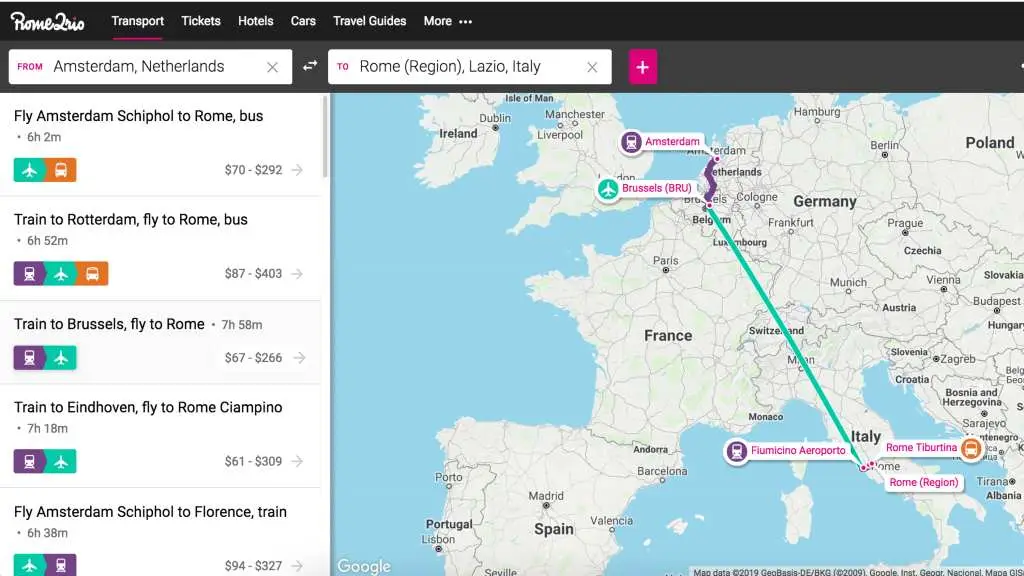
Rome2Rio is especially useful when a route is not obvious. A sustainable travel app roundup describes it as a tool that shows almost every possible way to travel between two places worldwide, including bus, train, ferry, plane, and carpool, while also surfacing eco-friendly alternatives to cars or planes along with estimated prices and booking links. That makes it particularly valuable in the earliest phase of planning, when you are still asking, “Can I get there without flying?”
The strength of Rome2Rio is breadth. Instead of forcing travelers to search each mode separately, it reveals the structure of a route across different transport systems. For sustainable travel, that matters because people often choose flights simply because they do not know the overland options. Rome2Rio helps expose those options quickly. Its limitation is that it is more of a route discovery engine than a full itinerary manager, so most travelers will need another app to organize bookings and day-by-day plans.
Wanderu
Wanderu is one of the most useful apps for travelers who want to prioritize train and bus travel, especially in North America and Europe. A travel-tech guide explains that Wanderu compares bus and train options and can place them side by side with flight alternatives, encouraging travelers to consider ground transportation when practical. The same source also notes that Wanderu’s routing technology can combine trips from different operators to create more efficient itineraries.
That multi-operator capability is important because sustainable travel often depends on stitching together routes across separate rail and coach companies. Instead of checking each provider one by one, travelers can use Wanderu to find workable combinations faster. It is particularly helpful for budget-conscious travelers, since buses and trains can sometimes beat flights on total cost once airport transfers and extra fees are considered. The main limitation is geography: its usefulness depends on the regions and operators it covers.
TrainConnections
For travelers focused on European rail, TrainConnections is a specialized tool built around international train planning. Its app listings describe it as an interactive train map that helps users find reachable destinations across Europe, including direct and multi-stop journeys, while offering filters for changes, duration, and distance. The app explicitly presents itself as a tool for sustainable train travel and aims to make rail planning easier than less sustainable alternatives.
This kind of app matters because one of the biggest barriers to sustainable travel is not willingness but visibility. Many travelers are open to taking trains, but they do not know what is realistically reachable from a given city without spending hours on fragmented rail websites. TrainConnections solves that discovery problem in a rail-specific way. It is less useful outside Europe, but for intra-European overland travel it can be one of the most targeted tools available.
Byway and Biliki
Some apps and platforms go beyond route comparison and try to design a sustainable trip for you. A destination-management guide identifies Byway as a flight-free travel platform that builds personalized holidays using trains, buses, and ferries, with an AI-powered planning system called JourneyAI and a focus on local businesses and lesser-known destinations. The same guide describes Biliki as a platform that generates sustainable itineraries quickly and aims to lower users’ carbon footprints through eco-friendly recommendations.
These tools are useful for travelers who want inspiration as well as logistics. Instead of only answering “How do I get there?”, they also help answer “What kind of sustainable trip should I take?” That makes them especially appealing for people who want to avoid flights altogether or redesign a vacation around lower-impact movement. Their weakness is that they are more curated and less universal than something like Google Maps, so they may suit trip ideation better than daily navigation.
Wanderlog
Wanderlog is not a sustainability-first app, but it is highly useful for organizing sustainable routes once you have chosen them. Travel app reviews and the company site describe it as an itinerary planner with interactive maps, route visualization, daily schedules, booking import, group collaboration, budgeting, and multi-stop trip organization. That makes it valuable for sustainable travel because low-impact trips often involve more legs and more coordination than a simple round-trip flight.
Its biggest contribution is structure. A no-fly or low-carbon route may include a long-distance train, a ferry, a local bus, several accommodations, and a few walking or cycling days. Wanderlog helps keep all of that in one place. It also works well for collaborative travel, which matters when one person in a group is trying to advocate for greener options without creating planning chaos. The limitation is that it does not replace route discovery tools; it works best after the route has already been researched.
Eco-driving and support apps
Not every sustainable route avoids driving completely. In regions with weak public transport, travelers may still need a car for part of the trip. In those cases, route efficiency matters. The Evaluway Eco Trip Planner app says it compares route options using metrics such as fuel cost, time, distance, and CO2 emissions, helping drivers choose routes that save money and reduce emissions. This kind of tool is useful for road trips, rural travel, and hybrid itineraries where trains handle the long leg and a car covers the final stretch.
Other support apps can improve sustainability without doing all the route planning themselves. App roundups mention FairTrip for finding more sustainable local businesses and destinations, while broader sustainable app lists also highlight tools that help with lower-waste decisions, refill stations, and conscious consumption on the road. These are not route planners in the strict sense, but they support the overall goal of building a trip with lower impact.
What makes an app good for sustainable routes
The best sustainable route apps usually share a few practical qualities. First, they compare multiple transport modes instead of assuming a flight or car trip is the default. Rome2Rio, Google Maps, and Wanderu all stand out here because they expose trains, buses, ferries, walking, and other alternatives.
Second, they reduce complexity. Specialized tools like TrainConnections help travelers understand what is reachable by rail, while itinerary builders like Wanderlog keep more complex routes manageable. Third, they align with the traveler’s actual constraints. A strong app is not just “green” in theory; it helps users find routes that are affordable, clear, and realistic enough to choose in practice. That is why sustainable route planning often works best with a stack of apps rather than a single perfect one.
Which app is best for which traveler
Different travelers need different tools, and the best app depends on how you travel.
| Traveler type | Best-fit apps |
|---|---|
| Everyday traveler trying to choose lower-impact local or regional routes | Google Maps, because it combines transit, walking, cycling, and fuel-efficient driving in one familiar interface. |
| Traveler comparing overland alternatives to flights | Rome2Rio and Wanderu, because they surface trains, buses, ferries, and multi-operator routes. |
| European rail traveler | TrainConnections, because it focuses specifically on international train planning in Europe. |
| Traveler designing a no-fly holiday | Byway and Biliki, because they build sustainable itineraries rather than only showing raw routes. |
| Traveler organizing a multi-stop low-carbon trip | Wanderlog, because it maps itineraries and keeps bookings and route logic together. |
| Driver trying to reduce emissions on necessary road travel | Evaluway Eco Trip Planner, because it compares routes by cost, time, distance, and CO2 impact. |
Better planning, better travel
The rise of sustainable travel depends partly on infrastructure, but it also depends on information. When travelers can see train options clearly, compare ferries with flights, organize complex overland routes, and spot lower-emission alternatives in real time, greener travel becomes much easier to choose. App ecosystems now make that possible in a way that was far harder even a few years ago.
The best app for planning sustainable travel routes is rarely just one app. In practice, most travelers will benefit from using a discovery tool such as Rome2Rio, a route and navigation tool such as Google Maps or TrainConnections, and an itinerary organizer such as Wanderlog. Together, those tools make lower-impact travel more visible, more practical, and more likely to happen.