
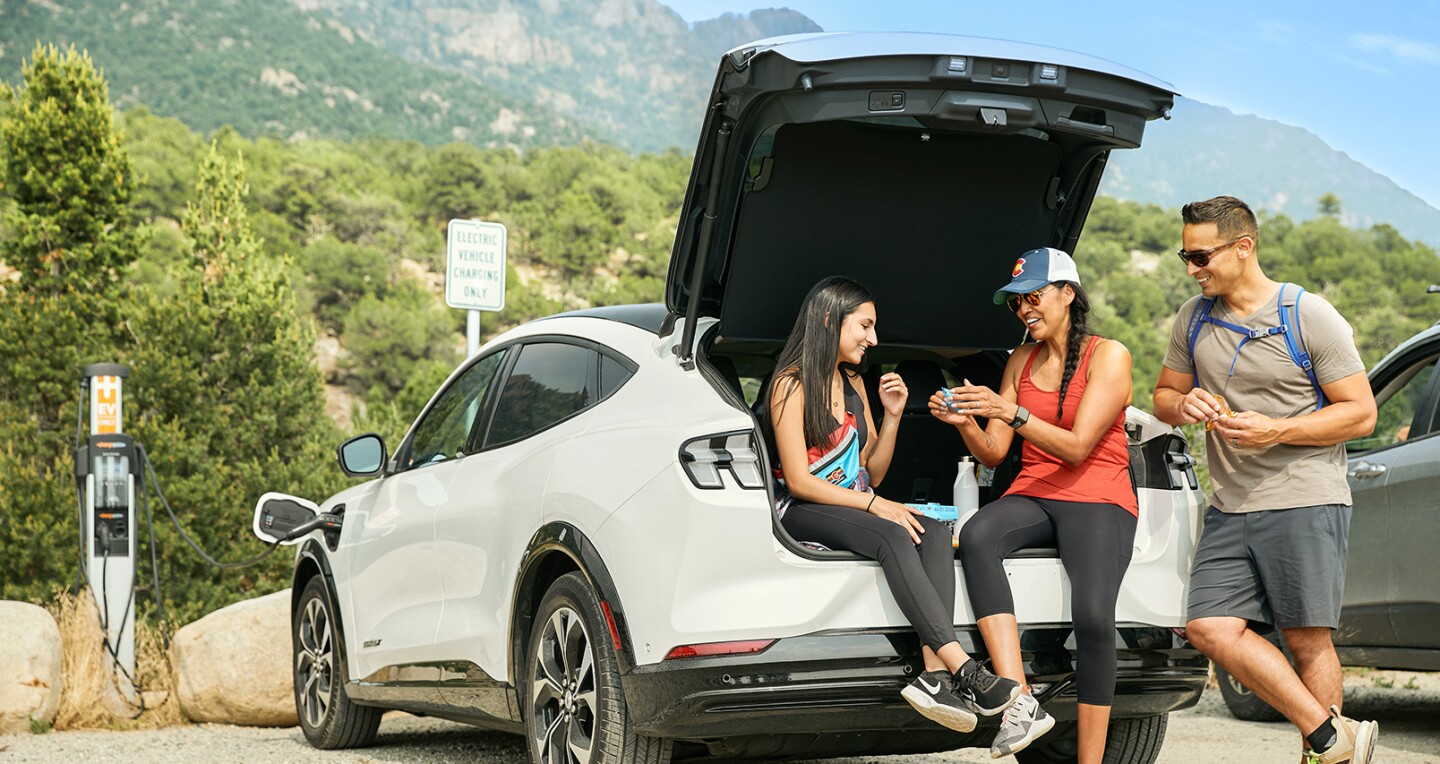
As travelers become more aware of their environmental impact, short-haul flights are facing growing scrutiny. For many regional journeys, the old assumption that flying is always the smartest option no longer holds up. Electric road trips are emerging as a more sustainable alternative, especially for travelers covering relatively short to medium distances, traveling with companions, or exploring destinations that are easier to reach by road than by air. Research comparing transport emissions shows that domestic and short-haul flights tend to have relatively high carbon intensity, while electric vehicles can offer much lower life-cycle emissions than gasoline cars and, in many cases, a better climate profile than flying on shorter routes.
This shift is being driven by two changes at once. First, more travelers are rethinking the environmental cost of frequent flying. Second, electric vehicles are becoming more viable for intercity travel thanks to wider charging networks, better battery range, route-planning tools, and growing public familiarity with EV travel. The result is a new kind of trip that combines lower emissions with flexibility, scenic travel, and the ability to explore more than one destination along the way.
Why short-haul flights are a problem
Short-haul flights are especially carbon-intensive because takeoff and landing use a large share of the fuel burned during the journey. Our World in Data explains that flights under 1,000 kilometers have particularly high carbon intensity per passenger-kilometer because the energy-heavy takeoff phase makes up a larger proportion of the total trip. That is why a domestic or short regional flight can have a surprisingly high footprint even if the actual time in the air is brief.
The numbers make this easier to understand. Our World in Data reports that national rail emits around 35 grams of CO2 per passenger-kilometer, while a domestic flight emits around 246 grams per passenger-kilometer. The same source notes that flying has a higher carbon footprint than a medium-sized car for journeys under 1,000 kilometers, which is exactly the distance range where many short-haul flights operate.
That does not automatically mean every car trip beats every flight. Occupancy matters, fuel type matters, and trip length matters. But the core point is clear: short flights are often worse than people assume, which opens the door for cleaner alternatives such as train travel, coach travel, and increasingly, electric road trips.
Why electric road trips are different
Electric vehicles change the road-trip equation because they eliminate tailpipe emissions and usually produce much lower life-cycle greenhouse gas emissions than gasoline vehicles. According to the International Council on Clean Transportation, battery electric vehicles in the European Union are estimated to have life-cycle greenhouse gas emissions of 63 g CO2e/km using the projected 2025–2044 average EU electricity mix, which is 73% lower than gasoline internal combustion vehicles estimated at 235 g CO2e/km.
That figure is important because it looks beyond the common criticism about battery manufacturing. The same ICCT analysis notes that electric vehicles have higher production emissions, mainly because of the battery, but those additional emissions are typically offset after about 17,000 kilometers of use in the first one or two years. In other words, the climate case for EVs is not just about what comes out of the tailpipe; it still holds when life-cycle impacts are included.
For road trips, this makes a major difference. A traditional gasoline car may compete with flying only under certain conditions, such as multiple passengers sharing the ride. An electric vehicle improves that comparison substantially by lowering emissions from the road segment itself. That means an EV road trip can outperform a short-haul flight not only in the experience it offers, but also in its overall climate logic.
Road travel gets cleaner with more passengers
One of the biggest advantages of road travel is that emissions are shared across everyone in the vehicle. Terrapass explains that while driving solo is not always better than flying, the break-even point in one cross-country example was about 2.03 people, meaning that when three or more people travel together, driving becomes the lower-emission option in that scenario. Google Sustainability also states that driving with passengers is a more climate-friendly travel choice than flying.
This principle becomes even stronger when the car is electric. Instead of simply dividing the emissions of a gasoline vehicle across multiple passengers, travelers are sharing a much lower-emission transport mode from the start. That makes EV road trips especially attractive for couples, families, and small groups who might otherwise book short regional flights.
The benefit is easiest to see on shorter routes. Terrapass gives an example of a 200-mile trip where a flight would emit around 109 pounds of CO2 per passenger, while a solo car trip would emit about 120 pounds per passenger; with four people in the car, that falls to about 30 pounds per passenger. That example refers to a conventional car, not an EV, which suggests that an electric road trip with several passengers could compare even more favorably against a short-haul flight.
Flexibility is part of the sustainability
Sustainability is not only about carbon math. It is also about designing trips that reduce unnecessary movement, avoid repeated transfers, and make better use of the journey itself. Electric road trips support this by allowing travelers to move directly between places without airport transfers, security lines, baggage handling, and extra urban transport at each end.
That flexibility can reduce waste in subtle ways. A short-haul flight often turns one simple trip into multiple segments: a drive to the airport, airport waiting time, the flight itself, and then another transfer on arrival. An EV road trip can turn that same journey into one continuous route, often with useful stops in towns, natural areas, and charging points that can double as meal or rest breaks.
This encourages a different style of travel. Instead of rushing to maximize distance in the shortest possible time, road trippers often travel more slowly and explore more intentionally. That slower pace can support local businesses, spread spending across smaller communities, and make the journey part of the destination rather than just a transition.
Charging is making EV trips more practical
A few years ago, the idea of a long electric road trip felt risky for many travelers. That is changing. Better battery ranges, route-planning tools, and more visible charging infrastructure are making EV travel easier to manage. Recent travel-tech commentary points to carbon calculators and smarter travel-planning tools as part of modern decision-making around car-versus-flight choices.
This practical improvement matters because sustainability only works when people can realistically use the lower-impact option. Electric road trips are becoming viable not because every route is perfect, but because enough routes now have the infrastructure and planning support to make them manageable. Travelers can increasingly map charging stops in advance, choose accommodations near chargers, and use apps that estimate energy use by terrain, speed, and weather.
There are still limits, of course. Charging times remain longer than refueling a gasoline car, and infrastructure quality varies by country and region. But for the kinds of journeys that compete with short-haul flights—regional vacations, intercity leisure travel, and weekend breaks—the EV road trip is becoming less of an experiment and more of a mainstream option.
When electric road trips work best
Electric road trips are most compelling on routes where flying is short, the destination is reachable within one day or a comfortable split drive, and the traveler benefits from local mobility on arrival. They are also especially strong when more than one person is traveling together, since shared occupancy improves the emissions case even further.
They work best for itineraries where flexibility matters. A traveler visiting a national park, coastal route, wine region, or multi-stop regional circuit may gain much more from a car than from a flight. In these cases, an electric vehicle can preserve the practical freedom of road travel while sharply lowering the environmental cost compared with a gasoline trip.
The case is also stronger in places with cleaner electricity. The ICCT notes that EV emissions fall further when powered by renewable electricity, with life-cycle emissions dropping to 52 g CO2e/km when renewable electricity is used, which is 78% lower than gasoline cars in its EU analysis. So the greener the grid, the greener the road trip.
Limits and honest trade-offs
Electric road trips are not a universal replacement for flying. On very long routes, flying may still be more practical in time terms, and in regions with poor charging access, EV travel may be stressful or unrealistic. There are also environmental impacts linked to battery production, mining, and vehicle manufacturing, even if the overall life-cycle picture remains significantly better than gasoline cars.
It is also true that public transport often beats private car travel on emissions per passenger. Google Sustainability notes that public transport is generally the better option because it carries more passengers, and Our World in Data shows that trains often have much lower emissions than both cars and planes. That means electric road trips should be seen as one sustainable option, not always the best one in every case.
Still, compared with short-haul flights, EV road trips fill an important gap. Not every route has good rail. Not every traveler can rely on buses. And not every destination is centered around a station. For these real-world cases, the electric road trip offers a practical middle path between convenience and climate responsibility.
Electric road trips are becoming a sustainable alternative to short-haul flights because they combine lower life-cycle emissions, shared occupancy benefits, growing infrastructure, and route flexibility in a way that fits many real travel patterns. They are particularly compelling for regional journeys where flights are carbon-intensive, road access is straightforward, and the traveler wants freedom to explore beyond a single arrival point.
For eco-conscious travelers, that makes the EV road trip more than a transport trend. It represents a broader shift in how travel is imagined: less centered on speed for its own sake, and more focused on lower-impact movement, better use of the journey, and smarter choices about when flying is truly necessary.